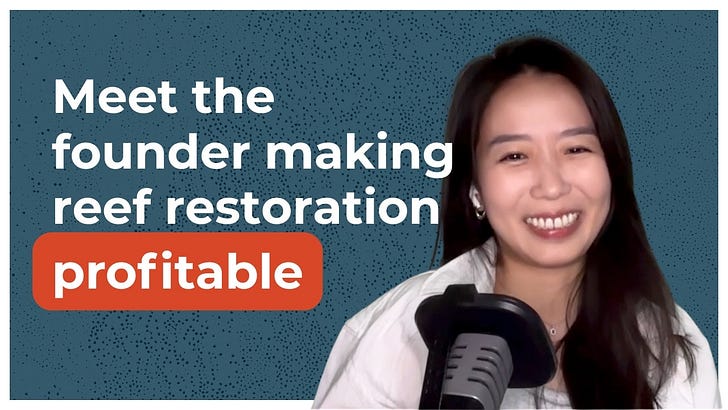


There’s a scene in Julia Taylor’s story that I can’t stop thinking about.
It’s October 24, 2018. She’s sitting on a plastic sofa in an RV parked in Moab, Utah. Her parents are visiting. She’s refreshing a screen, waiting for her very first sale — a $97 course she built in real time for a beta group of women who wanted to learn what she’d taught herself: how to code, how to build a website, how to start a business from scratch.
The sale comes through. Then another. By the time she sits down for breakfast, over 90 women have signed up. That’s $13,000 in revenue for a product that didn’t fully exist yet.
Today, Geek Pack has trained over 10,000 women entrepreneurs in digital skills, reaches more than 150,000 through its community and platforms, and is marching toward a vision of equipping 1 million women by 2030. Julia is a 2024 Cartier Women’s Initiative Fellow, has landed close to half a million dollars in non-dilutive grant funding, and built a brand partnership with Verizon that started with a shared vision and a post-conference handshake.
She’s done all of it bootstrapped. Profitable from day one. No VC. Four people on the team.
In our conversation on the Helping Billions Podcast, Julia was refreshingly honest about every part of the journey — the parts that worked, the parts that didn’t, and the gut-wrenching moments in between. Here’s what stood out.
1. You Don’t Need VC to Build Something That Matters
Silicon Valley has done an incredible job of equating ambition with fundraising. But Julia’s story is a reminder that massive impact doesn’t require outside capital — it requires a clear problem, relentless customer listening, and the willingness to start before you’re ready.
Julia launched Geek Pack by selling a course she hadn’t built yet: “It’s gonna be a beta launch. It’s gonna be a ridiculously low price and I’m gonna build it in real time.”
That’s not sloppy. That’s lean startup methodology in its purest form — validate demand before you build the product. And the economics tell the story: that first beta turned into a multi-million-dollar program.
This matters for impact entrepreneurs especially. Research from Capchase found that bootstrapped SaaS companies outperformed VC-backed peers across nearly every financial metric in 2022, including growth efficiency and margin. And only about 3% of startups ever secure venture capital. For the vast majority of founders — especially those in social enterprise — bootstrapping isn’t the backup plan. It’s the actual plan.
Julia put it plainly: “I love being for profit and I really love owning my entire business because I get to make all the decisions. If I want to create 10 scholarships for people to go through our program, I get to do that. Just like that.”
That’s the kind of agility VC-backed founders trade away.
2. A Big, Scary Vision Is a Business Strategy — Not a Poster on the Wall
In late 2021, Julia enrolled in a program about transitioning from small business owner to CEO. The first assignment was to articulate her mission, vision, and core values.
Her initial reaction? “Come on, like that’s so corporate, that’s so fluffy. Let’s get on to the meat of it.”
She was wrong. And she’ll tell you herself it was one of the most important things she’s ever done for the company.
Her coach gave her a deceptively simple framework for building a vision: include a number and a period of time. That’s it. Not a paragraph. Not corporate jargon. A number and a deadline.
Her first vision was to support 100,000 women in five years. She was terrified to say it out loud. They hit it in two years. So they went bigger: equip 1 million women by 2030 to build profitable, sustainable, impactful businesses.
What makes this powerful isn’t just the aspiration — it’s the operational discipline it creates. Jim Collins and Jerry Porras called this a BHAG (Big Hairy Audacious Goal) in Built to Last. Their research found that visionary companies using bold, clear goals outperformed comparison companies in fourteen out of eighteen cases studied. A good BHAG is tangible, energizing, and requires no explanation. People “get it” right away.
Julia’s version of this? She literally tracks how many times per week she says the vision statement out loud. Her team can rattle it off in seconds. Her community members email to say they’re proud to be part of it.
“One of my KPIs as a CEO is how many times a week do I say our vision statement.”
That’s not vanity. That’s alignment.
3. “Talk to People” Is Not Cliché — It’s the Entire Strategy
We all know the advice: talk to your customers. What Julia actually demonstrates is how — especially when you’re starting from zero.
She didn’t have a research budget. She didn’t hire a consulting firm. She used Instagram stories, a free Facebook group, and an email list. She told stories about her life — traveling in an RV, building a business — and then asked questions and listened to the answers.
“I built this ecosystem where my ideal audience is coming to me telling me what their problems are, and I’m able to talk to them one-on-one.”
The insight wasn’t complicated: women wanted to start businesses but didn’t know how to do the tech part and felt too intimidated to ask for help in existing spaces. Julia had lived this exact problem herself. When she was learning to code, she went to forums for help and got mocked.
So she created the opposite: “I’m going to create a community where there is no such thing as a silly question and where mean people are not allowed.”
The lesson for entrepreneurs isn’t just “go talk to people.” It’s: create a low-friction way for your target audience to talk to you, add value before asking for a credit card, and build in public so people can self-select into your community. What Julia describes is essentially a modern version of the Lean Canvas process — problem discovery through direct engagement, not assumptions.
4. The Hardest Part of Mission-Driven Leadership Isn’t Growth — It’s Contraction
Here’s where Julia’s honesty made the conversation extraordinary.
After explosive growth in 2020-2022 (fueled by a perfectly timed free event called Geek Week right when COVID hit), the business started contracting. Ad costs rose. Consumer spending shifted. Revenue strategies that had worked for years stopped working. By the end of 2023, Geek Pack was six figures in the red.
Julia tried everything. Workforce development. Nonprofit partnerships. Grant applications. She called it the “spray and pray method.” The team went from ten people to six, and then she hit the wall.
“It was April 1st of this year, sitting here at my desk, my husband walks in and I think it had just hit me. And he’s like, oh, how’s your day going? And I just fell apart because I realized that I had to — I literally did not have another option except to let people go.”
What made the layoffs even harder: the team members she had to let go had come from her own community. Women she had trained. Women who believed in the mission.
For mission-driven founders, this is the gut punch that Silicon Valley’s “fire fast” advice doesn’t fully account for. When your team members are also your community members, and your mission is about empowering people, letting someone go isn’t just a business decision — it’s a contradiction of everything you’re building.
But here’s what Julia did right that every founder should learn from:
She was transparent about finances from the start. When the hard conversations came, “no one was surprised because I was transparent with the whole team about the financial state that we were in.”
She knew how her team members preferred to receive bad news. Through personality assessments and direct conversations, she’d asked team members early on: how do you want to receive difficult information? Some preferred reading it first. She honored that.
She kept explanations factual, not emotional. “Very little of it was emotion or feeling. It was all data points.”
She didn’t regret fighting to keep people. “On the people side, I don’t think I would have done anything different because I am very confident knowing now that I literally did everything I could to keep them as long as possible. And that I’m proud of.”
If you lead a team, here’s your takeaway: the investments you make in transparency, trust, and understanding your people during good times are exactly what carry you through the worst times. You won’t know when you’ll need them, but you will.
5. Your “Competitor” Might Be Your Best Partner
One of the most surprising turns in Julia’s story happened at a conference. She was on stage, sharing Geek Pack’s vision — 1 million women by 2030 — when someone from Verizon approached her afterward.
“No way, that’s our vision too.”
Verizon runs a program called Small Business Digital Ready. Julia had always assumed they were competition. Instead, they became one of her biggest revenue streams through a brand partnership.
That one conversation reframed Geek Pack’s entire business model. Julia realized that brands — banks, fintech companies, insurance companies, software tools — wanted access to her trusted community of women small business owners. This created what she calls a “double flywheel”: individuals come into Geek Pack for training and community, while aligned brands pay for access to that audience.
“My audience trusts me. If I say go and use this tool, they probably are.”
The lesson: if you’ve built trust with a specific audience, that trust is an asset. And your biggest growth opportunity might come not from selling more to your existing customers, but from partnering with organizations that want to serve the same people.
6. Invest in Coaches, Even When You Think It’s “Hogwash”
Julia was candid about dismissing the idea of business and mindset coaching early on: “I heard like a business coach and mindset coach and I remember thinking to myself, that is complete hogwash.”
She was wrong about that, too. Her business coach and mindset coach — both of whom she’s worked with since 2017 — have been two of the most important investments in her journey.
“I really thought that was hogwash when I first started. But now I know — I’m very self-aware. I know what I’m good at. I know where my strengths don’t lie and where I can rely on other people.”
This extends to her team. When one team member needed upskilling to manage brand partnerships, Julia invested roughly $8,000 in coaching for her. That investment led directly to a $35,000 contract.
“I’m a big believer in hiring for passion because skills can be taught.”
Research backs this up. As James Clear outlines in Atomic Habits, sustainable transformation isn’t about willpower — it’s about systems and environment. Julia has built both: coaches who expand her thinking, habits that ground her (make the bed, empty the dishwasher — inspired by Admiral McRaven), and a team culture that values learning over credentials.
7. Grants Are Real Money for For-Profit Impact Companies
Here’s a number that should get every impact entrepreneur’s attention: Julia has secured $445,000 in non-dilutive grant funding as a for-profit company. Ranging from $5,000 to $250,000. No fiscal sponsorship required. Cash in the bank, use it how you want.
Her advice is practical:
Look for grants specifically for for-profit impact companies. They exist, and the pool is growing as more funders recognize that profitable businesses can drive social impact at scale.
You need to prove impact. The vision, the data, the women whose lives changed — that’s what makes the application compelling. Julia notes: “We already had the evidence to kind of say this is what we have done; with grant funding, we can do more.”
Hire a grant writer — or at least learn from one. Julia’s first grant — $250,000 from the state of Colorado — was written by a copywriter who knew how to tell the story in narrative form. “She wrote this in story, like a story, and we got the grant.” Julia has repurposed that language for every grant since, including the Cartier Women’s Initiative fellowship.
If you’re a purpose-driven for-profit company and you haven’t explored grants, you’re leaving money on the table.
The Bottom Line
Julia Taylor’s story isn’t about a unicorn exit or a mega-round. It’s about something arguably harder and more instructive: building a profitable, purpose-driven business through sheer resourcefulness, brutal honesty, and a willingness to grow — personally — alongside the company.
She went from teaching herself to code in a vacuum, to building a community of tens of thousands, to surviving the kind of financial crisis that ends most businesses, to emerging on the other side with a leaner team, a clearer strategy, and a partnership model that could scale the mission further than she ever imagined from that RV in Moab.
The through-line? She built it the hard way, on her own terms, and she owns every piece of it.
For the impact entrepreneurs, funders, and business leaders reading this: Julia’s path is proof that scale isn’t the only way. Sometimes the most powerful thing you can do is build something small, purpose-driven, and profitable — and let the impact compound from there.
Want to Learn from Purpose-Driven Founders?
Subscribe to the Helping Billions Podcast.
Have a founder we should interview? Have them apply here, or nominate them here.