

If you’re building a social enterprise to last, you’re signing up for a decade or more of HARD work. And the longer you’re at it, the more life shows up uninvited. A parent dies. You get married. Friendships fade. The market collapses the week before your Series B.
Most founder advice doesn’t account for any of this. It’s tuned for a sprint: eighteen months to product-market fit, forty-eight to a Series A, and an exit story that fits on a Forbes cover. Mission-locked founders don’t run that race. We’re building things that take a decade or two to actually matter, and the only way to make it that long is to build the conditions for your own survival into the work itself, and to do the same for the people building it with you.
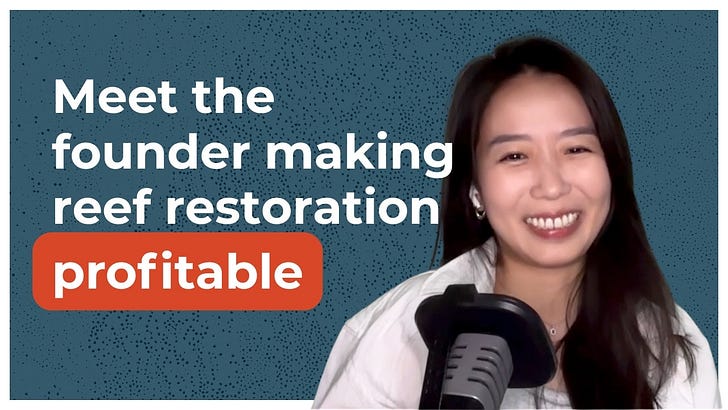
Steph Speirs spent ten years building Solstice, a community solar company that made clean energy accessible to roughly four out of five Americans who can’t put panels on their own roof. She sold it to Mitsui in October 2022, the last good year for clean-energy M&A before the market turned. She’d just buried her father. She’d just gotten married. The thing she’s most proud of isn’t the exit. It’s that she made it through as a real person, even more in tune with the people and world around her. And now, she’s at it again with her latest venture, Future in Bloom.
In this amazing interview with Steph, we uncover what I’m calling the Founder Sustainability Stack: five concrete things she built, on purpose, that let her keep building when most founders would have given up.
1. Find a peer cohort. Don’t let it dissolve.
Steph applied to twenty grants in Solstice’s early days. Twenty rejected her. Echoing Green was the first to say yes. But the money wasn’t the highlight of this Fellowship, the cohort of peers was. Eleven years later, Steph’s group still gathers monthly.
“There’s a group of us that have been meeting for now eleven years on a monthly basis and sharing our ups and downs.”
This isn’t networking. It’s something more specific. A founder spends her day managing everyone else’s motivations: the team, the board, the customers, the investors. Almost no one in her life is allowed to see her scared, confused, or stuck. A peer cohort is the room where she’s allowed.
The data on founder mental health is grim. Research by Michael Freeman at UCSF found that roughly half of entrepreneurs report a mental health condition, and they’re significantly more likely than the general population to experience depression and anxiety. The thing that protects against it isn’t grit. It’s other founders.
If your fellowship doesn’t fund the cohort, fund it yourself. Find five founders at your stage in adjacent industries (not competitors). Lock in a monthly call before you need it. The version of this you build at year two will save you at year seven.
2. Build a real support network outside the company.
Founders are professional motivation managers. The job is to be the steadiest person in every room. Somewhere in your life, you need people who get to see the other version. The version that’s terrified, exhausted, or genuinely lost.
For Steph, that was her partner. She was able to share things with him she couldn’t share with even her co-founder, because she was always, in her words, “managing everyone else’s motivations.” Her co-founder needed her to be steady. Her husband didn’t.
This looks different for everyone. For some founders it’s a partner. For others it’s a parent, a sibling, a friend group from college, a therapist they’ve kept for a decade, a chosen family. The form doesn’t matter. The non-negotiables are that it exists, that it’s not transactional, and that it gets protected like real infrastructure.
Research on entrepreneurial wellbeing keeps landing in the same place: perceived social support is a stronger predictor of founder mental health than money raised, market traction, or hours worked. The founders who last aren’t grinding alone. They built a network of people who knew them before the company and will know them after.
3. Innovation comes from your own scars plus exposure to worlds that aren’t yours.
Solstice’s most original product wasn’t a solar farm. It was the Energy Score, a proprietary credit-scoring system based on utility repayment history rather than mortgages and credit cards. Steph built it because most solar financiers require a FICO score of 680 or above, and roughly half of America doesn’t have one. The product that was supposed to save people money on their electricity bill was excluding the people who needed those savings most.
Why did Steph see this when other solar founders didn’t? Two reasons. One personal, one structural.
The personal reason was her mom: a single immigrant parent raising three kids in Hawaii on a salary below the poverty line. A bad credit score. A boss at a call center who once told her to go back to her old country. Steph remembers her mom telling her, and it’s worth slowing down to read this:
“In America, your credit score is your destiny. It determines whether you can get a car or an apartment or sometimes even a job. Even though we have a bad credit score, it does not mean we’re bad people.”
The structural reason: before Solstice, Steph was in a fellowship at Acumen, serving in low-income villages in India and Pakistan. She watched microfinance institutions there pioneer alternative measures of creditworthiness, using social connectivity, behavioral data, and mobile-money repayment history. All of this was years before any US bank looked twice at the idea. M-Pesa was leapfrogging Apple Pay in East Africa.
“I love the idea of taking solutions from the global South and bringing them to The United States, because there’s this hegemony of thinking that the West exports all the innovation out to the global South, and that’s just not the case.”
Vijay Govindarajan at Tuck has been writing about this dynamic for years. He calls it reverse innovation. Most US founders never look in that direction. They benchmark against US competitors, attend US conferences, hire US talent, and miss models that are five years ahead in markets they’ve written off as poor.
The CFPB estimates roughly 26 million American adults are credit invisible (no FICO file at all), and another 19 million have files too thin to score. Those people pay rent on time. They pay their phone bills on time. The system just doesn’t see them. Steph saw them because her mom was one of them, and because she’d already watched another country build an answer.
If you want a product nobody else can copy, the formula is straightforward. Find the problem your own life made you angry about. Then go spend serious time in the place that’s solving it differently than your industry knows how to.
4. Grow yourself at least as fast as the company.
By year seven at Solstice, Steph had collapsed her identity into the work.
“I had given up everything in my life. I put off a lot of things for work. It was my entire identity. It’s what I did from when I woke up to when I went to sleep.”
This isn’t a moral failing. It’s what the founder role rewards in the short term. Push harder. Sleep less. Take the meeting. Skip the social gathering. Cancel the trip. Every individual decision looks rational. The aggregate decision is a structural risk: you become a person whose entire being depends on a single company performing. That hurts both the human and the company that human is supposed to be leading.
Steph’s recovery was learning to keep becoming a person. She took up free diving in Hawaii during the pandemic. (Sixty feet down on a single breath of air after one weekend of training. She’d been afraid of swimming deeper than three feet before that, which she joked was a little embarrassing for someone from Hawaii.) She took up spear fishing. She reconnected with the Hawaiian view of nature as ancestor, not environment.
When she was preparing for what came next, she made three lists. Everything she’s worse at than the average person. Everything she’s better at than the average person. What she wanted her life outside of work to look like. The third list, she told me, didn’t exist when she started Solstice. At the end of a decade, it was the one that mattered most.
The hidden lesson under the lesson came from free diving. The panic feeling underwater, when your body is screaming for air? That’s not actually your need to breathe. It’s CO2 buildup. The fix is to slow down.
“When your instinct is to freak out, the answer is to probably go more slowly.”
5. How you treat your people is the strategy. Not in addition to it.
Here’s the question Steph never got asked.
She raised significant capital across multiple rounds. She went through extensive diligence with multiple investors. Fund analysts, partners, MBAs with spreadsheets, the works.
“Never once did I get asked by an investor: how do you retain your talent? How do you treat your people? And that is one of the most important reasons why a business succeeds or fails.”
Solstice didn’t hire its first HR person until year eight. Steph and her co-founder split the role between them. She calls it a huge mistake. People problems don’t wait for the founder to have time. They explode. Without a specialist, every blowup landed in the founders’ laps and pulled them away from the work that only they could do.
The proof of how much her team mattered came when her father died. For the first time in eight years, Steph couldn’t go to work. She told her chief of staff and her co-founder she needed two weeks. The company kept running.
Note who carried the company when she couldn’t. Not her vision. Not her IP. Not her investor relationships. Her people.
A note for impact investors. If your diligence checklist asks about TAM, churn, CAC, LTV, and unit economics but skips retention, culture, and how the founder treats her team, you’re missing the leading indicator that predicts whether any of the other numbers will hold. Gallup’s research on engagement has shown for decades that engaged teams outperform on profitability, productivity, and retention. The data isn’t new. The diligence frameworks just haven’t caught up.
For founders, the play is straightforward. Hire HR earlier than feels necessary. Build the leadership bench so the company doesn’t stop with you when something falls out of the sky and lands in your lap. When Steph left at the end of 2024, “everyone just moved up one spot.” Her co-founder became CEO. The company kept going. That’s what a real team looks like.
Proof the stack works
Here’s the test of whether any of this actually holds up.
When Steph left Solstice at the end of 2024, the company didn’t blink. Her co-founder became CEO. Everyone moved up one spot. The leadership bench she’d been building for years held. Solstice kept doing what Solstice was built to do.
Steph took six glorious weeks off. Then Yale asked her to teach a class on commercializing climate tech, the first time she’d been back on campus in twenty years. She said yes, and then pushed Yale to let her share the curriculum publicly:
“It’s not great that only 60 very privileged students get access to this curriculum that’s not really readily available in the world.”
That request became the seed of Future in Bloom, her new media studio. Steph’s read on the moment is direct. The cultural conversation about climate has been losing ground to political theater. Clean energy creates jobs and prosperity in places that need both, and the stories aren’t being told.
“Narrative and storytelling seem like a big gap. And I don’t know that the social enterprise space does it very well.”
Future in Bloom is adapted from Steph’s Yale School of Management course on Climate Tech Innovation and Commercialization, supported by the Yale Center for Business and the Environment. It combines studio interviews with climate tech founders, scientists, and investors with short documentaries shot in the field. So far the team has shipped a film about the largest geothermal plant in the country, in a Utah town of 1,600 people who love it. They’re producing one on the geopolitics of fusion energy after crisscrossing the US to meet the companies building it. Last month Steph was in the Navajo Nation filming a solar project. The thesis is the same as Solstice’s: clean energy is good for the people the dominant narrative usually leaves out, and someone needs to make it impossible to keep ignoring them.
Note what’s underneath all of this. A founder who made it through one decade with peer support, a partner she could lean on, a self that exists outside her work, a worldview wider than her industry, and a team that could carry the company without her — gets to do this again. Not from depletion. From choice.
That’s what the stack is for.
All flourishing is mutual
In the interview, Steph talked about the book The Serviceberry by Robin Wall Kimmerer, author of the best-selling book, Braiding Sweetgrass. In it, Kimmerer shares that the foundational law of the natural world: all flourishing is mutual.
(Side note: I devoured this book the week following our interview and I can’t recommend it enough!)
The founder who flourishes alone is a myth.
The founder who flourishes for a decade does it because she built five things, on purpose: a peer cohort, a support network, a self that exists outside her work, a worldview wider than her industry, and a team that can carry the company when she can’t carry herself.
Build the stack early. Protect it.
The work will take longer than you think. The life around it will be harder than anyone warned you. And if you build this right, both of them will still be standing in ten years, and you’ll be flourishing in the world.
What’s in your stack?
Want to Learn from Purpose-Driven Founders?
Have a founder we should interview? Have them apply here, or nominate them here.