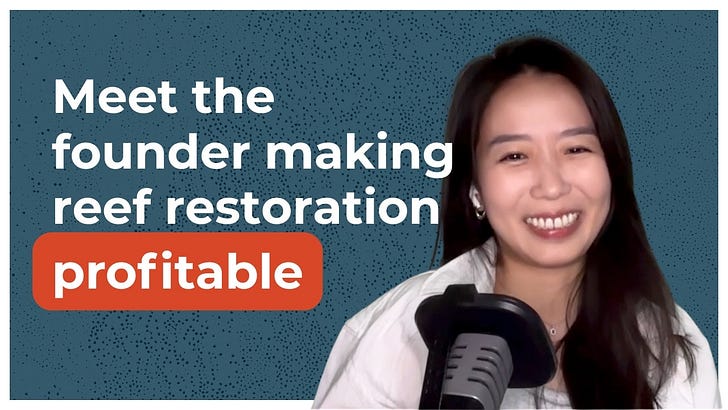


In 2021, Disruptia won what every early-stage social enterprise thinks they want: A big business-to-business contract with one of Colombia’s biggest financial groups. Train 200 people across 28 municipalities. Digital marketing, data analytics, front-end development, UX, e-commerce. English on the side. Then, help them find work.
They placed three.
“We directly employed three people of 200. It was bad.”
That’s Paula Porras, co-founder of Disruptia, a Colombian workforce platform that exists because the labor market in Latin America runs on a lie. The story most companies tell themselves is that qualified talent is scarce. Paula and her co-founders tell a different one: eight million working-age Colombians are ready and willing to do the job. Women, victims of the armed conflict, young people from rural areas, people with disabilities, people whose parents never went to university. The talent isn’t missing. The bridge is.
Take Carine. She’s 23, from a low-income family in Bogotá. No one in her family went to university. She had the right attitude, a growth mindset, a desire to work. But without a bachelor’s degree or formal job experience, no traditional platform would match her. So to earn a living, she handed out flyers at traffic lights, day and night, dodging cars and motorbikes. Disruptia calls people like Carine “disruptors.” She’s one of 8 million. Disruptia creates more stable and higher earning career pathways for people like Carine, and it is life-changing.
The ILO confirms the shape of the problem: youth unemployment across Latin America and the Caribbean sits at 13.8%, nearly three times the adult rate. In Colombia specifically, about 44.7% of young workers are employed informally. No contract, no pension, no protection.
So the math is brutal. And the dream contract nearly broke Disruptia before they understood any of what they understand now.
Here’s what Paula learned. Six lessons that won’t show up in a VC deck but might be the most useful thing a social entrepreneur reads this month.
Before the lessons: the moment Disruptia was born
Paula started in corporate finance, got her heart broken in 2012, and signed up to volunteer at a Colombian nonprofit called Somos Capaces as a distraction. The volunteering turned into her life. She ran the organization for years, trained people in conflict resolution across Colombia, Kenya, Pakistan, Syria, the Philippines.
Then in 2018 she and her co-founders heard something that changed everything. A young man who’d been one of their brightest students at Somos Capaces had graduated and couldn’t find work.
“He was unlocking wrapped cell phones. For a gang. Because he couldn’t find a job when he graduated from school, so he needed to earn a living. He was really smart.”
That’s the tension Disruptia lives in every day. The talent isn’t the problem. The opportunity to use the talent legally, formally, and at a living wage. That’s the problem. Every contract they take is an attempt to close that gap for one more person. And sometimes, as in 2021, the attempt fails spectacularly.
Lesson 1: Scale kills mission-driven work before product-market fit does
Disruptia had placed cohorts of 7 and 21 people in Bogotá. When the financial group said do 200 across 28 municipalities in six months, they said yes.
They didn’t have contacts in most of those municipalities. The internet dropped in and out. Participants couldn’t relocate. And Disruptia didn’t know the local employer ecosystems well enough to make matches.
Paula’s diagnosis is blunt:
“We needed humility. We weren’t bold enough. We didn’t know. We were really new in the employability part. So I think we overestimated the game.”
The lesson isn’t don’t scale. It’s that scale in social work requires the same ingredient as scale in distribution. Dense local networks. Jumping from two regions to twenty-eight didn’t just multiply operational complexity. It multiplied every single thing that only works when you know the people on the ground. If you can’t recruit locally, employ locally, and troubleshoot locally, you’re not running a program. You’re running a press release.
Lesson 2: Bounce back by sharing responsibility. Don’t carry the bag alone.
This is the lesson most social entrepreneurs miss, and Paula names it with an almost-English word she keeps using: corresponsibility. When a program isn’t working, go back to the client. Not away from them.
“I think we’re good at explaining bad results sometimes.”
What Disruptia learned after the financial group contract wasn’t how to hide failure. It was how to turn it into a conversation where the client owns part of the outcome.
“This is not just like one standalone project where you just are going to succeed. Because the employment sector is really complicated. It’s evolving, and it’s a different dynamic that it was 10 years ago.”
If students aren’t showing up, something in the program design, or the client’s expectations, or the labor market context is off. Not just your execution. Share the diagnosis. Share the responsibility. That’s how you keep the relationship alive long enough to do better work with the same client. It’s also how Disruptia turned a failed contract into credibility. The financial group that gave them the nightmare contract became the reference that opened every subsequent door.
Lesson 3: Relationships aren’t a distraction. They’re the moat.
Early on, Paula watched David (her co-founder and partner) spend what she thought was absurd amounts of time networking. She was the work-focused one. Results. Output. Results. Output.
“I was like, you’re wasting time with other things. What are you doing with all of these lunches?”
She was wrong. Every government contract Disruptia won later traced back to a relationship David built in a year when they didn’t seem to be producing anything.
“All of those relationship really paid off. Even if that wasn’t his intention, just cultivating those relationships at the end was really some of the things that also gave us contract opportunities.”
The B2G (business-to-government) market in Colombia has bid minimums and track-record requirements that lock out most early-stage players. Relationships and alliances with organizations that already qualify are how you get in. Not a pitch deck. Not a cold email. A lunch, three years in advance.
Lesson 4: Don’t send that aggressive email. Grab lunch instead.
Under delivery pressure, founders default to clear, pointed written communication with clients and partners. And it lands like a slap.
“Many of the things that have worked for us was like, ‘let’s grab some lunch’, or ‘how are you feeling?’ Really building that relationship, really trying to understand the struggle of the other person.”
This isn’t soft skills. It’s the difference between a client who renews and a client who walks. Your participants and your clients both have their own pressures. Earned empathy separates operators from consultants.
Lesson 5: Get the right people on the bus. Then keep changing the seats.
Disruptia started with three co-founders, then four. All industrial engineers. All from Somos Capaces. Paula references Jim Collins’s famous framing from Good to Great:
“You have to get the right people on the bus and then see where to go.
Collins’s full idea: leaders who transform companies don’t start with where. They start with who. Right people on the bus, wrong people off, right people in the right seats. Then decide where to drive.
Where Disruptia’s version is instructive specifically for social enterprise founders: the seats have to keep moving. Paula started as director. David took over. Paula Franco (a fourth co-founder) took over. Sebastián moved from technology to technology plus finance and back. Every year, they re-evaluated who was delivering and adjusted.
“You cannot continue to do that every year. That can be a little bit of inconsistent. But at the beginning, we had to make a lot of adjustments.”
Translation: early-stage social enterprises aren’t built by people doing the same job for five years. They’re built by people willing to rotate into whatever seat the business needs next. This is especially true when you’re bootstrapping. You don’t have the option of hiring in a specialist. You grow into the seat, or you leave the bus.
Lesson 6: Late team decisions are the most expensive mistake you’ll make
I asked Paula what her biggest learning was. She didn’t hesitate.
“Not making team decisions at the right time because it’s too costly.”
“It’s a toxic relationship. Just cut that. You can cut it in a good way that is healthy for both parts.”
The research is with her. Management writing on startups consistently finds that leaving underperformers in place costs more than the awkward conversation of parting ways. Gallup estimates that replacing an employee costs 30% to 400% of their salary. In a small mission-driven team, a bad fit doesn’t just cost you salary. It costs you the energy of the people around them, the decisions they make that have to be un-made later, and the trust of clients who notice. The founder who waits six months to make a decision they already know is right is subsidizing a problem at the expense of their best people.
A closing note on the “plush toy” problem
When I asked Paula why she and her co-founders incorporated Disruptia as a for-profit rather than a nonprofit, her answer was about being taken seriously in a market.
“The mindset was different of being in a nonprofit than a social enterprise.”
There’s a version of the nonprofit sector where your work gets a pat on the head instead of a real contract. Where doing good work means being tolerated, not competed with. Disruptia’s co-founders watched colleagues leave Somos Capaces because the organization couldn’t pay them what they needed. They weren’t going to build that again.
The choice has a cost. No tax-deductible donations, harder grant pipeline. But the payoff is real: they operate in the HR tech market as peers, not as charity cases. And in employability, where the buyer is almost always a company, that shift is what let them raise the stakes.
Disruptia has trained more than 5,000 people and placed close to 1,000. They’ve won a grant from Bridge for Billions, an Acumen Angels grant, and a zero-interest loan from IKEA’s NEST. All at zero equity. They’re preparing for a pre-seed round to grow the platform.
Paula’s not done. When I asked her what grounds her when things get hard, she didn’t reach for a framework. She reached for a moment.
“Going on the ground, to be in touch with the people that we serve.That really grounded me.”
Eight million people in Colombia want a job. Disruptia is building for them one municipality at a time, one seat on the bus at a time, one hard team decision at a time. That’s the work.
Want to Learn from Purpose-Driven Founders? Subscribe to the Helping Billions Podcast. Have a founder we should interview? Have them apply here, or nominate them here.